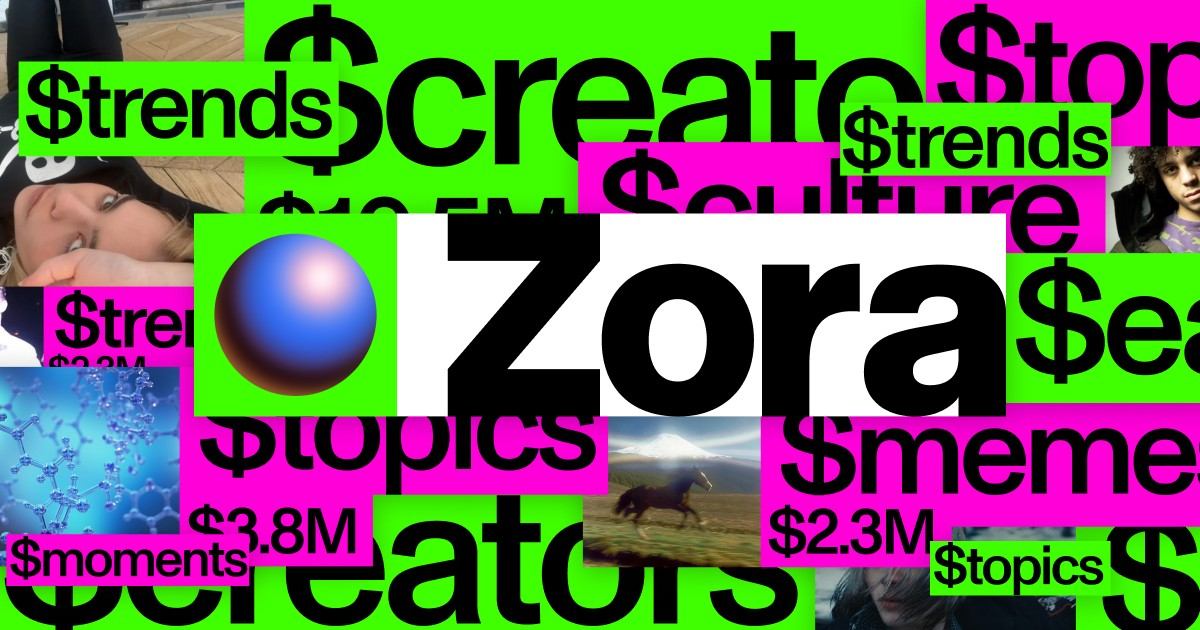
Zora app is a culture-trading interface for taking positions on memes, topics, and moments
Zora app is a social trading experience built around cultural timing: users take positions on ideas, memes, and moments before they spread widely. It turns attention into a market signal, so a trending post, creator, phrase, or internet-native event becomes something people can back with capital. The core appeal is simple: if your read on culture is early, the app gives that intuition a market format.
Trading culture before the crowd arrives
The distinctive idea is that attention itself becomes the object of trading. Rather than treating culture as background noise around crypto, the product makes social momentum the main surface. A user scans what is moving, decides whether a moment has room to grow, and opens a position tied to that belief. That makes the experience feel closer to a fast social feed than a traditional exchange screen.
This format suits internet cycles because memes, creator posts, and public conversations move faster than conventional assets. A moment begins in a small corner of the feed, spreads through reposts and group chats, and either fades or becomes a larger cultural reference. Zora app gives that path a tradable shape without requiring the topic to become a full project, company, or long-term community.
What a position represents inside the app
A position is a direct expression of conviction about a topic's future attention. The user is not merely bookmarking a post or liking a trend; they are putting value behind a view that the market can price. This creates a feedback loop between discovery, social proof, and trading activity. Strong early interest brings more visibility, while weak follow-through leaves a position exposed to falling demand.
That mechanism makes the app different from a static NFT marketplace. The important unit is not only a collectible object or a profile image. It is the market around a live cultural signal. The same person who understands creator behavior, meme velocity, community language, or niche internet humor has a reason to participate because those forms of judgment become tradable inputs.
How discovery shapes each trade
The feed matters because timing matters. Users look for signs that a moment is breaking out: rapid reposting, recognizable creators joining the conversation, a joke leaving its original audience, or a narrative crossing from crypto circles into broader social media. Zora app is designed around this attention layer, so discovery is part of the trading workflow rather than a separate research chore.
Good entries come from understanding why something is spreading. A meme that works only inside one group has a different risk profile from a phrase that jumps across communities. A creator-driven topic behaves differently from a news-driven moment. The app rewards users who read context, not just charts, because the traded object is bound to social meaning.
Wallets, settlement, and onchain behavior
Because the product sits in the crypto economy, users should expect wallet-based actions, transaction confirmations, and visible costs around execution. The exact flow depends on the account setup and current app design, but the practical pattern is familiar: connect or create a wallet, fund it with supported assets, choose a market, review the transaction, and approve the action.
Onchain settlement gives positions a public, composable character. Trades exist in a wider Web3 environment where wallets, token balances, and market activity can interact with other crypto tools. That also means users need to treat approvals, account access, and transaction prompts as part of the product experience, not as background details.
Where Zora Network fits into the experience
Zora's broader ecosystem includes creator-focused infrastructure and an onchain network associated with media, minting, and cultural assets. That history matters because the app is not emerging from a generic exchange background. It extends a long-running focus on internet creativity into a faster market format where attention, not only finished artwork, becomes the center of activity.
More broadly, Zora app carries that creator-economy logic into social trading. The market does not need to wait for a polished collection launch or a formal token campaign. A live idea can become the thing people gather around. For users already familiar with NFTs, creator coins, and Layer 2 activity, this feels like a natural shift from owning finished media to trading the momentum around media.
Using it without treating every trend the same
The first useful habit is separating a real cultural signal from momentary noise. A trend with repeated references, fresh remixes, and participation from distinct communities has more depth than a single viral post. A topic tied to a creator with an active audience has different dynamics from a random phrase that spikes for an hour and disappears.
- Look for repeat engagement across more than one social cluster.
- Check whether the topic still attracts new posts after the first surge.
- Watch for creator involvement, not only anonymous trading activity.
- Size positions so a failed meme does not dominate the wallet.
- Review transaction details before approving any wallet prompt.
These habits do not remove volatility. They make each trade more intentional. Cultural markets move on attention, and attention changes direction quickly when a stronger joke, controversy, launch, or creator moment captures the feed.
What users actually use it for
Some people use the app as a discovery engine, treating markets as a ranked map of what the internet is starting to care about. Others use it as a speculative tool, backing topics they believe will travel farther. Creators and communities watch it because market activity reveals which narratives are pulling people in with enough force to attract capital.
Day to day, Zora app also appeals to users who already spend time interpreting online culture. A trader who follows crypto Twitter, creator communities, meme accounts, and emerging internet subcultures has inputs that a purely chart-based trader misses. The product turns that habit into a structured market action, which is why its language leans toward intuition, timing, and cultural alpha.
The main risk is attention decay
The largest risk is not technical complexity; it is the speed at which attention collapses. A topic that looks unstoppable in the morning can lose energy by evening. Prices tied to cultural enthusiasm react sharply when the crowd moves on, liquidity thins, or a later entrant buys after the easy attention has already arrived.
There is also a behavioral risk. A feed built around fast-moving ideas encourages quick decisions, and quick decisions favor overconfidence. The strongest users will treat a position as a thesis about distribution: who will care, why they will share it, and how long the story has room to run. That mindset is sturdier than buying every green move that appears near the top of the feed.
How it differs from prediction markets and memecoin venues
Prediction markets center on event outcomes: election results, policy decisions, sports events, or measurable public facts. Memecoin venues center on tokens launched around a joke, identity, or community. Zora app sits closer to culture trading because the object is a live social moment, and the market expresses belief in its spread rather than a binary event result.
That distinction changes the skill set. A prediction trader studies probabilities and resolution criteria. A memecoin trader studies token distribution, liquidity, and community intensity. A user here studies social velocity, creator networks, and whether a moment has a reason to keep reproducing. Those skills overlap, but they are not the same.
Getting started with a small, readable trade
A new user should begin with a market they understand from context, not one chosen only because it is moving. The cleanest first trade is tied to a topic you can explain in one sentence: what it is, who cares about it, and why it should attract more attention. If that explanation feels vague, the position is probably just a reaction to noise.
After choosing a topic, review the available balance, estimated transaction cost, and order details before confirming. Then track both the market and the surrounding conversation. Zora app makes the trade visible, but the reason for the trade still lives in the feed, the creator graph, and the pace of new references. Selling is also a decision about attention: when the story stops expanding, the thesis has changed.
Who gets the most value from this style of app
The product works best for people who already have a sharp read on internet culture and want a faster way to express it. It is less about passive holding and more about recognizing when a topic is crossing from niche awareness into broader demand. That includes crypto-native traders, creator-economy participants, meme analysts, and users who treat online conversation as a serious signal.
Importantly, Zora app is compelling because it gives cultural judgment a direct market interface. It does not make every trend valuable, and it does not turn virality into certainty. It creates a place where early attention, social understanding, and risk-taking meet. For users who enjoy reading the internet before the internet reads itself, that is the central reason to care.
What to know about Zora app
Fees on Zora app: what costs should a new user expect?
A user should expect trading costs tied to execution and blockchain activity, including transaction fees shown before approval. The important habit is reading the confirmation screen before signing, because small positions are more sensitive to fees. Costs shift with network conditions and app mechanics, so the visible quote at the moment of trade matters more than a fixed rule.
Can creators benefit when their topics become tradable?
Creators benefit most when a tradable topic brings attention back to their work, community, or cultural moment. Market activity can amplify discovery because people follow what others are backing. That does not mean every creator gains directly from every trade, so the real value is visibility, community energy, and a clearer signal around which ideas are resonating.
Which signals matter before opening a position on a meme or moment?
Useful signals include repeated posting across different communities, participation from recognizable creators, fresh remixes, and continued discussion after the first spike. A single viral post is weaker than a topic that keeps generating new references. The strongest setup is a moment with a clear audience, obvious shareability, and enough room to travel beyond its original niche.
Is Zora app closer to NFTs, memecoins, or prediction markets?
It overlaps with all three but fits most closely as culture trading. NFTs focus on owned media, memecoins focus on tokens around identity or jokes, and prediction markets focus on defined outcomes. This app centers on taking positions around live topics, memes, ideas, and moments before broader attention catches up.